
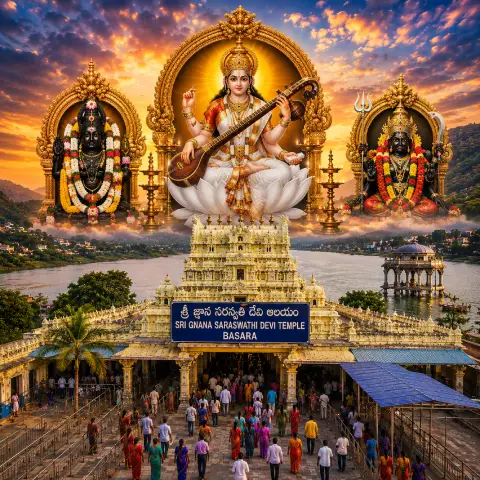
Sri Gnana Saraswathi Devi Temple, Basara – Overview
Introduction
Located on the banks of the sacred Godavari River at Basara in Nirmal district of Telangana, Sri Gnana Saraswathi Devi Temple is one of the most important temples dedicated to Goddess Saraswathi in South India. Goddess Saraswathi, the divine embodiment of knowledge, wisdom, learning, speech, music and the arts, is worshipped here as Sri Gnana Saraswathi Devi.
The temple is particularly famous for the traditional Aksharabhyasam or Akshara Sweekaram ceremony, in which young children are ceremonially introduced to education and the writing of their first letters. Families from Telangana, Andhra Pradesh, Maharashtra, Karnataka and other parts of India visit Basara to seek the blessings of Goddess Saraswathi before their children begin formal education.
Basara occupies a spiritually significant location beside the Godavari River. The temple and its surrounding sacred landscape are closely associated with Sage Veda Vyasa, Goddess Saraswathi and the traditional presence of Saraswathi, Lakshmi and Mahakali. Because of this association with the divine feminine trinity, Basara is also described in temple tradition as a sacred abode of knowledge, prosperity and spiritual power.
The Telangana Tourism Department recognizes the Gnana Saraswathi Temple as one of the few important Saraswathi temples in India and specifically identifies Basara as a major destination for Aksharabhyasam. :contentReference[oaicite:1]{index=1}
The Legend of Sage Veda Vyasa
According to the traditional Sthala Purana, Sage Veda Vyasa came to the region of Dandakaranya after the great Kurukshetra war. Seeking a peaceful and spiritually suitable place for meditation, he travelled south and eventually reached the serene surroundings of the Godavari River.
The sage was deeply impressed by the peaceful natural environment and chose the region around the Kumarachala hills as a place for penance. He is traditionally believed to have established his hermitage here and spent considerable time in meditation and worship of the Divine Mother.
According to the traditional account, after taking his daily bath in the Godavari, Veda Vyasa would collect three handfuls of sand from the river and place them in three separate heaps. Through his devotional power, these heaps are believed to have manifested as forms of the Divine Mother.
The three forms are traditionally identified with Goddess Saraswathi, Goddess Lakshmi and Goddess Mahakali. Although the temple is primarily dedicated to Goddess Saraswathi, the presence of these three divine forms is an important part of the religious identity of Basara.
The Endowments Department records this traditional association of Veda Vyasa with Basara and the manifestation of the three deities. The account should be understood as a sacred temple tradition rather than as independently verified historical evidence. :contentReference[oaicite:2]{index=2}
Origin of the Name Basara
The origin of the name Basara is traditionally connected with Sage Veda Vyasa. According to one temple tradition, the region was originally associated with the name Vasara or Vyasara because of Vyasa Maharshi's prolonged presence and penance here.
Over time, the name is traditionally said to have evolved into Basara or Basar. Another explanation associates the later form of the name with the linguistic influence of the Marathi-speaking regions surrounding northern Telangana.
These explanations belong to local historical and devotional traditions, and different sources preserve slightly different versions of the name's origin.
Goddess Gnana Saraswathi
The principal deity of Basara is Sri Gnana Saraswathi Devi, the Goddess of knowledge and wisdom. Saraswathi is traditionally depicted as the divine source of learning, refined speech, music, literature, arts, wisdom and intellectual understanding.
At Basara, the Goddess is especially revered by students, teachers, scholars, artists, musicians and families seeking blessings for the education and intellectual development of children.
The distinctive devotional tradition of the temple is that children are brought before Goddess Saraswathi at the beginning of their educational journey. The first letters are traditionally written during Aksharabhyasam in the presence of the Goddess.
The Divine Trinity of Basara
Basara is traditionally associated with three important forms of the Divine Mother: Saraswathi, Lakshmi and Mahakali.
- Goddess Saraswathi – associated with knowledge, learning, wisdom, speech, music and the arts.
- Goddess Lakshmi – associated with prosperity, abundance, fortune and auspiciousness.
- Goddess Mahakali – associated with divine power, protection, courage and the destruction of evil.
The presence of these three forms is traditionally understood as representing the three complementary dimensions of human and spiritual life: knowledge, prosperity and power.
The temple's principal worship is dedicated to Goddess Saraswathi, while the associated shrines and images of Lakshmi and Mahakali contribute to Basara's wider sacred identity. The Telangana Endowments Department specifically notes the presence of Saraswathi, Lakshmi and Mahakali at the site. :contentReference[oaicite:3]{index=3}
Aksharabhyasam – Initiation into Learning
Aksharabhyasam is the most distinctive religious tradition associated with Basara. The word refers to the ceremonial introduction of a child to letters and learning.
Parents traditionally bring their children to the temple before the beginning of formal schooling. In the presence of Goddess Saraswathi, the child is guided to write the first letters as a symbolic beginning of the educational journey.
The ceremony expresses the traditional Hindu belief that education is a sacred pursuit and that learning should begin with the blessings of the Goddess of Knowledge.
Children may write sacred syllables such as “Om” or the first letters of their chosen language as part of the ceremony. Books, pens, pencils, notebooks and other educational materials may also be offered to the Goddess as acts of devotion.
Aksharabhyasam is performed throughout the year, but the ceremony is especially popular during Vasantha Panchami and other auspicious occasions associated with Saraswathi worship. The Government of Telangana specifically identifies Basara as a major destination for this educational initiation ceremony. :contentReference[oaicite:4]{index=4}
Turmeric and the Goddess
A distinctive devotional tradition at Basara is the association of Goddess Saraswathi with turmeric. Traditional accounts describe the deity as having a sacred connection with turmeric and the sand forms created by Sage Vyasa.
Devotees have traditionally regarded the turmeric associated with the Goddess as sacred and auspicious. Some devotional traditions also hold that consuming a small quantity of the sacred turmeric symbolically brings wisdom and intellectual clarity.
This belief is part of the temple's devotional tradition and should be understood as a religious practice rather than as a scientifically established effect.
Kumarachala and Vyasa Cave
The sacred landscape around Basara includes the Kumarachala hill, which is traditionally associated with Sage Vyasa and his period of penance.
A cave known as Vyasa Guha is associated with the sage's meditation. Devotees visit the cave and nearby sacred places as part of the broader Basara pilgrimage.
The association of the hills, caves, Godavari River and temple creates a pilgrimage landscape in which natural surroundings are closely integrated with religious tradition.
History
The history of Basara is connected with the wider historical development of the Godavari region and northern Telangana. Traditional accounts associate the temple with Sage Vyasa, while historical sources indicate that the region was also connected with medieval Chalukyan political and religious activity.
Telangana school educational material describes the Basara Saraswathi Temple as having been built on the banks of the Godavari during the Chalukyan period. Other historical traditions associate the temple's development with medieval rulers and local patrons. However, the exact construction history of every present structure cannot be attributed to a single ruler solely on the basis of these traditional accounts. :contentReference[oaicite:5]{index=5}
The temple has undergone reconstruction and renovation over different periods. Local temple history records that approximately two centuries ago, the shrine was rebuilt after local devotees protected the site from destructive attacks. This account is part of the temple's later historical tradition.
The continued worship of Goddess Saraswathi, the development of Aksharabhyasam as a major pilgrimage practice and the preservation of associated sacred sites have allowed Basara to remain an important religious and cultural centre.
The Temple Complex
The Sri Gnana Saraswathi Temple complex is situated close to the Godavari River and contains the principal Saraswathi shrine together with associated sacred spaces and subsidiary temples.
The main shrine follows the South Indian temple tradition and is surrounded by religious structures used for worship, ceremonies and devotee activities.
The sanctum is associated with Goddess Saraswathi, with Goddess Lakshmi represented alongside her. A separate Mahakali shrine is also an important part of the sacred complex.
The temple complex includes spaces associated with Aksharabhyasam, daily worship, special sevas and festival celebrations. The wider Basara pilgrimage area also includes the Vyasa Maharshi Temple, Vyasa Guha, Vedavathi Shila, Shiva shrine and other sacred sites. The temple Endowments Department lists these places among the important sites associated with Basara. :contentReference[oaicite:6]{index=6}
Papaharini Pushkarini
The Papaharini Pushkarini, also known as Koneru, is an important sacred water body located near the temple.
Traditional temple accounts describe eight sacred Theerthas associated with the Pushkarini, corresponding to the eight directions. These are traditionally known as Indra Theertha, Surya Theertha, Vyasa Theertha, Valmiki Theertha, Vishnu Theertha, Ganesha Theertha, Putra Theertha and Shiva Theertha.
The Pushkarini is traditionally regarded as a sacred place for ritual bathing and spiritual purification. Temple tradition associates the waters with the removal of sins and the attainment of spiritual merit.
These descriptions belong to the religious tradition surrounding Basara and should not be interpreted as scientifically verified claims about the physical properties of the water. The Telangana Endowments Department records the eight Theerthas associated with the Pushkarini. :contentReference[oaicite:7]{index=7}
Associated Sacred Places
- Sri Gnana Saraswathi Temple – the principal shrine dedicated to Goddess Saraswathi.
- Sri Mahakali Temple – an important shrine associated with the Divine Mother and the Basara tradition.
- Sri Dattatreya Swamy Temple – an associated shrine located near the main temple area.
- Sri Vedavyasa Maharshi Temple – associated with Sage Veda Vyasa and his traditional connection with Basara.
- Vyasa Guha – the sacred cave traditionally associated with the meditation of Sage Vyasa.
- Vedavathi Shila – a sacred stone associated with local religious tradition.
- Sri Shivalayam – a Shiva shrine associated with the sacred landscape near the Godavari.
- Sri Venkateswara Swamy Temple – another religious site in the wider Basara area.
- Sri Ganesh Temple – an associated Ganesha shrine.
- Sri Papahareshwara Temple – another Shiva shrine associated with the pilgrimage landscape.
- Godavari River – the sacred river beside which Basara and its principal temple are situated.
The Telangana Endowments Department lists these locations among the historical and religious places associated with Basara. :contentReference[oaicite:8]{index=8}
Ritual Practice
Daily worship at Sri Gnana Saraswathi Temple follows established temple traditions dedicated to Goddess Saraswathi and the associated deities.
The traditional daily schedule begins in the early morning with the opening of the Goddess's temple, followed by the ceremonial bringing of water from the Godavari for Abhishekam. Abhishekam, alankarana, naivedyam and harathi form important parts of the daily worship cycle.
The temple's Endowments Department records early-morning Abhishekam, alankarana, Bala Bhogam, darshan, Maha Naivedyam and Maha Harathi among the regular daily activities. :contentReference[oaicite:9]{index=9}
Special services associated with the temple include Akshara Abhyasam, Nitya Chandi Yagam and Pallaki Seva. Pallaki Seva is traditionally performed on Fridays. :contentReference[oaicite:10]{index=10}
Major Festivals
- Vasantha Panchami – one of the most important celebrations at Basara and a major festival dedicated to Goddess Saraswathi. The day is traditionally associated with Saraswathi worship and is especially popular for Aksharabhyasam.
- Devi Navarathrulu – the nine-night Navaratri celebration is observed with special worship, alankarams, homams and devotional programmes dedicated to the Goddess.
- Dasara – the concluding period of Navaratri is celebrated with special religious ceremonies and worship of the Divine Mother.
- Vyasa Pournami – Guru Purnima is celebrated in honour of Sage Veda Vyasa, whose traditional association with Basara is central to the temple's Sthala Purana.
- Maha Shivaratri – an important festival in the Basara religious calendar, particularly because of the presence of Shiva shrines in the wider sacred complex.
- Datta Jayanti – the birth celebration of Lord Dattatreya is observed as one of the important festivals associated with the wider Basara pilgrimage tradition.
The temple's Endowments Department lists Vyasa Pournami, Dasara Navarathri, Datta Jayanti, Vasantha Panchami and Maha Shivaratri among the principal festivals of Basara. :contentReference[oaicite:11]{index=11}
Religious Significance
Basara has exceptional religious significance as a major centre for the worship of Goddess Saraswathi. Unlike most pilgrimage centres where Shiva, Vishnu or another major deity is the principal focus, Basara is particularly associated with knowledge and education through the worship of Gnana Saraswathi.
The temple's most important spiritual tradition is the belief that education should begin with divine blessings. Aksharabhyasam therefore transforms the beginning of a child's formal education into a sacred family ceremony.
The presence of Saraswathi, Lakshmi and Mahakali is traditionally interpreted as a combination of knowledge, prosperity and divine power. For devotees, these three aspects represent important foundations for a complete and purposeful life.
The Godavari River adds further sacred importance to the location. Pilgrims traditionally take a holy bath in the river before visiting the temple and participating in worship.
Cultural and Educational Importance
Basara occupies a unique position in the cultural life of Telangana because of its connection with education. Thousands of families visit the temple specifically to perform Aksharabhyasam for their children.
The temple therefore functions not only as a pilgrimage centre but also as a cultural symbol of the traditional Indian reverence for learning, teachers and knowledge.
The association of Basara with Sage Veda Vyasa further strengthens its connection with Indian literary and scriptural tradition. Vyasa is traditionally revered as the compiler of the Vedas and the author or principal redactor associated with the Mahabharata and many Puranic traditions.
Basara's location on the Godavari also connects the temple with the larger cultural landscape of the river, which has supported religious communities, pilgrimage centres and cultural traditions for centuries.
Basara and the Godavari River
The Godavari is an essential part of the spiritual identity of Basara. The temple is situated close to the river, and traditional accounts connect Sage Vyasa's worship with his daily bathing in the Godavari.
The river is regarded as sacred in Hindu tradition. Pilgrims traditionally take a bath in the Godavari before entering the temple and performing worship.
The combination of the river, Kumarachala hills, Vyasa-associated caves and the Saraswathi temple creates a distinctive sacred landscape in which nature and religious tradition are closely connected.
Why Visit Sri Gnana Saraswathi Devi Temple?
- To receive the blessings of Goddess Gnana Saraswathi, the Goddess of knowledge and wisdom.
- To perform Aksharabhyasam for children beginning their educational journey.
- To experience one of the most important Saraswathi pilgrimage centres in South India.
- To worship the traditional divine forms of Saraswathi, Lakshmi and Mahakali.
- To learn about the traditional association of Sage Veda Vyasa with Basara.
- To visit Vyasa Guha and other sacred places associated with the Basara pilgrimage.
- To visit the Papaharini Pushkarini and its traditionally associated sacred Theerthas.
- To take part in major celebrations such as Vasantha Panchami, Devi Navarathrulu and Vyasa Pournami.
- To experience the sacred atmosphere of the Godavari River.
- To introduce children to the traditional Indian cultural value of education and learning.
శ్రీ జ్ఞాన సరస్వతి దేవి ఆలయం, బాసర – అవలోకనం
పరిచయం
తెలంగాణ రాష్ట్రంలోని నిర్మల్ జిల్లాలో గోదావరి నది తీరంలో కొలువై ఉన్న శ్రీ జ్ఞాన సరస్వతి దేవి ఆలయం దక్షిణ భారతదేశంలోని ప్రముఖ సరస్వతి క్షేత్రాలలో ఒకటి. జ్ఞానం, విద్య, వాక్కు, సంగీతం, సాహిత్యం మరియు కళలకు అధిదేవతగా భావించే సరస్వతీ దేవిని ఇక్కడ శ్రీ జ్ఞాన సరస్వతి దేవిగా ఆరాధిస్తారు.
బాసర ఆలయానికి అత్యంత విశిష్టమైన ప్రాధాన్యత అక్షరాభ్యాసం లేదా అక్షర స్వీకార సంప్రదాయం. పిల్లలు తమ పాఠశాల విద్యను ప్రారంభించే ముందు తల్లిదండ్రులు వారిని బాసరలోని సరస్వతీ దేవి సన్నిధికి తీసుకువచ్చి మొదటి అక్షరాలను రాయించే సంప్రదాయం ఉంది. తెలంగాణ, ఆంధ్రప్రదేశ్, మహారాష్ట్ర, కర్ణాటక మరియు ఇతర ప్రాంతాల నుంచి అనేక కుటుంబాలు పిల్లల విద్యాభ్యాసం ప్రారంభానికి అమ్మవారి ఆశీస్సులు పొందేందుకు బాసరను దర్శిస్తారు.
గోదావరి నది తీరంలో ఉన్న బాసర క్షేత్రం ఆధ్యాత్మికంగా విశిష్టమైన ప్రదేశం. వేదవ్యాస మహర్షి, సరస్వతీ దేవి మరియు సరస్వతి, లక్ష్మి, మహాకాళి అనే దివ్య రూపాలతో ఈ క్షేత్రానికి సన్నిహిత సంబంధం ఉందని స్థలపురాణ సంప్రదాయం చెబుతుంది. అందువల్ల బాసరను జ్ఞానం, ఐశ్వర్యం మరియు దైవశక్తికి పవిత్ర నిలయంగా భక్తులు భావిస్తారు.
తెలంగాణ పర్యాటక శాఖ బాసర జ్ఞాన సరస్వతి ఆలయాన్ని భారతదేశంలోని కొన్ని ముఖ్యమైన సరస్వతి క్షేత్రాలలో ఒకటిగా పేర్కొంటూ, అక్షరాభ్యాసానికి ప్రముఖ పుణ్యక్షేత్రంగా గుర్తిస్తుంది. :contentReference[oaicite:12]{index=12}
వేదవ్యాస మహర్షి స్థలపురాణం
సంప్రదాయ స్థలపురాణం ప్రకారం మహాభారత యుద్ధం అనంతరం వేదవ్యాస మహర్షి మనశ్శాంతి కోసం తీర్థయాత్రకు బయలుదేరారు. ఉత్తర భారతదేశం నుంచి దక్షిణ దిశగా ప్రయాణిస్తూ దండకారణ్య ప్రాంతానికి చేరుకున్నారు. గోదావరి నది తీరంలోని ప్రశాంతమైన వాతావరణం ఆయనకు ఎంతో నచ్చి అక్కడే తపస్సు చేయాలని నిర్ణయించుకున్నారని సంప్రదాయం చెబుతుంది.
కుమారాచల కొండల పరిసర ప్రాంతాన్ని తన తపోస్థలంగా ఎంచుకుని వ్యాస మహర్షి అక్కడ ఆశ్రమాన్ని ఏర్పాటు చేసుకుని ధ్యానం మరియు దేవీ ఆరాధనలో గడిపారని స్థలపురాణం చెబుతుంది.
ప్రతిరోజూ గోదావరిలో స్నానం చేసిన తరువాత వ్యాస మహర్షి నది ఇసుకను మూడు పిడికిళ్లుగా తీసుకుని మూడు చిన్న ఇసుక దిబ్బలుగా ఏర్పరచేవారని సంప్రదాయ కథనం. తన భక్తిశక్తితో ఆ మూడు ఇసుక రాశులను దివ్య మాతృరూపాలుగా ఆరాధించేవారని చెబుతారు.
ఆ మూడు రూపాలను సంప్రదాయంగా సరస్వతీ దేవి, లక్ష్మీ దేవి మరియు మహాకాళి దేవిగా గుర్తిస్తారు. ఆలయం ప్రధానంగా సరస్వతీ దేవికి అంకితం చేయబడినప్పటికీ, ఈ మూడు దివ్యరూపాల ఉనికి బాసర క్షేత్ర ధార్మిక గుర్తింపులో ముఖ్యమైన భాగం.
తెలంగాణ దేవాదాయ శాఖ కూడా బాసర క్షేత్రాన్ని వేదవ్యాస మహర్షి సంప్రదాయంతో మరియు మూడు దేవతల ఆవిర్భావ గాథతో అనుసంధానిస్తుంది. ఈ కథను పవిత్ర స్థలపురాణ సంప్రదాయంగా చూడాలి; స్వతంత్ర చారిత్రక ఆధారంతో నిర్ధారించబడిన సంఘటనగా కాదు. :contentReference[oaicite:13]{index=13}
బాసర అనే పేరు
బాసర అనే పేరుకు సంబంధించి స్థానికంగా అనేక సంప్రదాయ వివరణలు ఉన్నాయి. వేదవ్యాస మహర్షి ఇక్కడ దీర్ఘకాలం నివసించి తపస్సు చేసినందున ఈ ప్రాంతాన్ని వాసర లేదా వ్యాసర అని పిలిచేవారని ఒక సంప్రదాయ వివరణ.
కాలక్రమేణా ఈ పేరు బాసర లేదా బాసర్గా మారిందని స్థానిక విశ్వాసం. ఉత్తర తెలంగాణ చుట్టుపక్కల ప్రాంతాల్లోని మరాఠీ భాషా ప్రభావం వల్ల కూడా పేరు రూపాంతరం చెందిందని మరో వివరణ చెబుతుంది.
బాసర అనే పేరుకు సంబంధించిన ఈ వివరణలు స్థానిక చారిత్రక మరియు భక్తి సంప్రదాయాలలో కనిపిస్తాయి. వివిధ మూలాల్లో వివరణల్లో కొంత వ్యత్యాసం ఉంటుంది.
జ్ఞాన సరస్వతి దేవి
బాసర క్షేత్రంలో ప్రధాన దేవత శ్రీ జ్ఞాన సరస్వతి దేవి. ఆమెను జ్ఞానం, విద్య, వాక్కు, సంగీతం, సాహిత్యం, కళలు మరియు వివేకానికి దైవిక స్వరూపంగా ఆరాధిస్తారు.
విద్యార్థులు, ఉపాధ్యాయులు, పండితులు, కళాకారులు, సంగీత విద్వాంసులు మరియు తమ పిల్లల విద్యాభివృద్ధి కోసం ఆశీర్వాదం కోరుకునే కుటుంబాలు అమ్మవారిని ప్రత్యేకంగా ఆరాధిస్తారు.
బాసర ఆలయానికి ప్రత్యేకమైన భక్తి సంప్రదాయం ఏమిటంటే, పిల్లల విద్యాభ్యాసాన్ని అమ్మవారి సన్నిధిలో ప్రారంభించడం. అక్షరాభ్యాసం సమయంలో అమ్మవారి సమక్షంలో పిల్లల చేత మొదటి అక్షరాలను రాయిస్తారు.
బాసర దివ్య త్రిమూర్తి సంప్రదాయం
బాసర క్షేత్రం సంప్రదాయంగా మూడు ముఖ్యమైన దివ్య మాతృరూపాలతో అనుసంధానించబడింది: సరస్వతి, లక్ష్మి మరియు మహాకాళి.
- సరస్వతి దేవి – జ్ఞానం, విద్య, వివేకం, వాక్కు, సంగీతం మరియు కళలకు ప్రతీక.
- లక్ష్మి దేవి – ఐశ్వర్యం, సంపద, అదృష్టం, శ్రేయస్సు మరియు మంగళానికి ప్రతీక.
- మహాకాళి దేవి – దైవిక శక్తి, రక్షణ, ధైర్యం మరియు దుష్టశక్తుల నిర్మూలనకు ప్రతీక.
ఈ మూడు దివ్యరూపాలను జ్ఞానం, ఐశ్వర్యం మరియు శక్తి అనే మానవ మరియు ఆధ్యాత్మిక జీవితంలోని మూడు ముఖ్యమైన అంశాలకు ప్రతీకలుగా భక్తులు భావిస్తారు.
ప్రధాన ఆరాధన సరస్వతి దేవికి జరుగుతున్నప్పటికీ, లక్ష్మి మరియు మహాకాళి దేవతల సన్నిధులు బాసర క్షేత్రం యొక్క విస్తృత ధార్మిక ప్రాముఖ్యతను పెంచుతున్నాయి. తెలంగాణ దేవాదాయ శాఖ కూడా బాసరలో సరస్వతి, లక్ష్మి మరియు మహాకాళి దివ్యరూపాల సంప్రదాయాన్ని నమోదు చేసింది. :contentReference[oaicite:14]{index=14}
అక్షరాభ్యాసం – విద్యాభ్యాసానికి శ్రీకారం
అక్షరాభ్యాసం బాసర క్షేత్రంతో అత్యంత విశిష్టంగా అనుసంధానమైన ధార్మిక సంప్రదాయం. ఈ పదం పిల్లలకు మొదటిసారిగా అక్షరాలను పరిచయం చేసి విద్యాభ్యాసానికి శ్రీకారం చుట్టే పవిత్ర కార్యక్రమాన్ని సూచిస్తుంది.
పిల్లలు పాఠశాలలో అధికారిక విద్యను ప్రారంభించే ముందు తల్లిదండ్రులు వారిని బాసర ఆలయానికి తీసుకువస్తారు. సరస్వతి దేవి సన్నిధిలో పిల్లల చేత మొదటి అక్షరాలను రాయించి వారి విద్యాభ్యాస ప్రయాణానికి శ్రీకారం చుడతారు.
విద్య ఒక పవిత్రమైన సాధన అని, జ్ఞాన దేవత ఆశీస్సులతో విద్యను ప్రారంభించడం శుభప్రదమని భావించే భారతీయ సంప్రదాయాన్ని అక్షరాభ్యాసం ప్రతిబింబిస్తుంది.
అక్షరాభ్యాసంలో పిల్లల చేత “ఓం” వంటి పవిత్ర అక్షరాలు లేదా వారి భాషలోని మొదటి అక్షరాలను రాయించే సంప్రదాయం ఉంది. పుస్తకాలు, పెన్నులు, పెన్సిళ్లు, నోట్బుక్కులు మరియు ఇతర విద్యా సామగ్రిని కూడా అమ్మవారికి సమర్పిస్తారు.
అక్షరాభ్యాసం ఏడాది పొడవునా నిర్వహించబడుతుంది. అయితే వసంత పంచమి వంటి సరస్వతి ఆరాధనకు సంబంధించిన పవిత్ర సందర్భాల్లో ఈ సేవకు ప్రత్యేక ప్రాధాన్యత ఉంటుంది. తెలంగాణ ప్రభుత్వం కూడా బాసరను అక్షరాభ్యాసానికి ప్రధాన తీర్థయాత్రా కేంద్రంగా గుర్తిస్తుంది. :contentReference[oaicite:15]{index=15}
పసుపు మరియు సరస్వతి దేవి
బాసర క్షేత్రంలో సరస్వతి దేవి ఆరాధనకు పసుపుతో ప్రత్యేక సంబంధం ఉన్నట్లు భక్తి సంప్రదాయం చెబుతుంది. వ్యాస మహర్షి ఇసుకతో రూపొందించిన దివ్యరూపాల సంప్రదాయంతో కూడా పసుపు అనుసంధానించబడింది.
అమ్మవారికి సంబంధించిన పసుపును భక్తులు పవిత్రమైనదిగా, మంగళకరమైనదిగా భావిస్తారు. ఈ పవిత్ర పసుపులో కొంత భాగాన్ని స్వీకరించడం ద్వారా జ్ఞానం మరియు వివేకం కలుగుతాయని కొన్ని భక్తి సంప్రదాయాలు విశ్వసిస్తాయి.
ఇది ఆలయ భక్తి సంప్రదాయానికి సంబంధించిన విశ్వాసం మాత్రమే. దీనిని శాస్త్రీయంగా నిరూపించబడిన ప్రభావంగా పరిగణించకూడదు.
కుమారాచల పర్వతం మరియు వ్యాస గుహ
బాసర చుట్టుపక్కల పవిత్ర ప్రాంతాలలో కుమారాచల కొండకు ప్రత్యేకమైన ప్రాధాన్యత ఉంది. ఈ ప్రాంతాన్ని వేదవ్యాస మహర్షి తపస్సుతో సంప్రదాయంగా అనుసంధానిస్తారు.
వ్యాస గుహ అనే పవిత్ర గుహ వ్యాస మహర్షి ధ్యానం మరియు తపస్సుతో అనుసంధానించబడింది. బాసర యాత్రకు వచ్చే భక్తులు ఈ గుహతో పాటు పరిసరాల్లోని ఇతర పవిత్ర ప్రాంతాలను దర్శిస్తారు.
కొండలు, గుహలు, గోదావరి నది మరియు సరస్వతి ఆలయం కలిసి బాసరలో ఒక ప్రత్యేకమైన పవిత్ర భౌగోళిక పరిసరాన్ని ఏర్పరుస్తాయి.
చరిత్ర
బాసర చరిత్ర గోదావరి ప్రాంతం మరియు ఉత్తర తెలంగాణ యొక్క విస్తృత చారిత్రక పరిణామాలతో అనుసంధానమై ఉంది. స్థలపురాణ సంప్రదాయాలు ఆలయాన్ని వేదవ్యాస మహర్షితో అనుసంధానిస్తుండగా, చారిత్రక మూలాలు ఈ ప్రాంతాన్ని మధ్యయుగ చాళుక్యుల కాలంలోని రాజకీయ మరియు ధార్మిక కార్యకలాపాలతో కూడా అనుసంధానిస్తాయి.
తెలంగాణ ప్రభుత్వ విద్యా పాఠ్యాంశాలలో గోదావరి నది తీరంలోని బాసర సరస్వతి ఆలయం చాళుక్యుల కాలంలో నిర్మించబడినదిగా పేర్కొనబడింది. ఇతర చారిత్రక సంప్రదాయాలు ఆలయ అభివృద్ధిని మధ్యయుగ పాలకులు మరియు స్థానిక దాతలతో అనుసంధానిస్తాయి. అయితే ప్రస్తుతం కనిపించే ప్రతి నిర్మాణ భాగాన్ని ఒకే రాజు లేదా ఒకే కాలానికి చెందినదిగా కేవలం ఈ సంప్రదాయాల ఆధారంగా ఖచ్చితంగా పేర్కొనడం సముచితం కాదు. :contentReference[oaicite:16]{index=16}
కాలక్రమేణా ఆలయం అనేక పునర్నిర్మాణాలు మరియు అభివృద్ధి దశలను చూసింది. స్థానిక ఆలయ చరిత్ర ప్రకారం సుమారు రెండు శతాబ్దాల క్రితం ఆలయాన్ని ధ్వంసం చేయడానికి ప్రయత్నించిన కొంతమంది దుండగులను స్థానిక భక్తులు తరిమివేసి, ఆలయాన్ని పునర్నిర్మించారని సంప్రదాయం చెబుతుంది.
సరస్వతి దేవి ఆరాధన, అక్షరాభ్యాస సంప్రదాయం మరియు అనుబంధ పవిత్ర ప్రాంతాల పరిరక్షణ వల్ల బాసర నేటికీ ముఖ్యమైన ధార్మిక మరియు సాంస్కృతిక కేంద్రంగా కొనసాగుతోంది.
ఆలయ సముదాయం
శ్రీ జ్ఞాన సరస్వతి దేవి ఆలయం గోదావరి నదికి సమీపంలో ఉన్న పవిత్ర ఆలయ సముదాయం. ప్రధాన సరస్వతి సన్నిధితో పాటు అనేక అనుబంధ పవిత్ర స్థలాలు మరియు ఉపాలయాలు ఈ సముదాయంలో మరియు పరిసరాల్లో ఉన్నాయి.
ప్రధాన ఆలయం దక్షిణ భారతీయ ఆలయ నిర్మాణ సంప్రదాయానికి అనుగుణంగా ఉంటుంది. భక్తుల పూజలు, అర్చనలు, అక్షరాభ్యాసం, ప్రత్యేక సేవలు మరియు ఉత్సవాల కోసం వివిధ ధార్మిక ప్రదేశాలు ఉన్నాయి.
గర్భగృహంలో ప్రధానంగా సరస్వతి దేవిని ఆరాధిస్తారు. ఆమెకు సమీపంగా లక్ష్మీ దేవి రూపం ఉండగా, మహాకాళి దేవికి ప్రత్యేక సన్నిధి ఉంది.
అక్షరాభ్యాసం, నిత్య పూజలు, ప్రత్యేక సేవలు మరియు ఉత్సవాల కోసం ఆలయంలో ప్రత్యేక ఏర్పాట్లు ఉన్నాయి. విస్తృత బాసర తీర్థయాత్రలో వ్యాస మహర్షి ఆలయం, వ్యాస గుహ, వేదవతి శిల, శివాలయం మరియు ఇతర పవిత్ర స్థలాలు కూడా భాగంగా ఉన్నాయి. తెలంగాణ దేవాదాయ శాఖ వీటిని బాసరతో అనుసంధానమైన ముఖ్యమైన పవిత్ర ప్రాంతాలుగా నమోదు చేసింది. :contentReference[oaicite:17]{index=17}
పాపహరిణి పుష్కరిణి
పాపహరిణి పుష్కరిణి లేదా కోనేరు ఆలయానికి సమీపంలో ఉన్న ముఖ్యమైన పవిత్ర జలాశయం.
ఆలయ సంప్రదాయం ప్రకారం ఈ పుష్కరిణికి ఎనిమిది దిశలకు అనుగుణంగా ఎనిమిది పవిత్ర తీర్థాలు ఉన్నాయి. వాటిని ఇంద్ర తీర్థం, సూర్య తీర్థం, వ్యాస తీర్థం, వాల్మీకి తీర్థం, విష్ణు తీర్థం, గణేశ తీర్థం, పుత్ర తీర్థం మరియు శివ తీర్థంగా పిలుస్తారు.
పాపహరిణి పుష్కరిణిని పవిత్ర స్నానం మరియు ఆధ్యాత్మిక శుద్ధికి అనుకూలమైన పవిత్ర స్థలంగా భక్తులు భావిస్తారు. ఈ తీర్థాలలో స్నానం చేయడం ద్వారా పాపాలు తొలగి పుణ్యం లభిస్తుందని స్థలపురాణ సంప్రదాయం చెబుతుంది.
ఈ వివరాలు బాసర ధార్మిక సంప్రదాయానికి సంబంధించినవి. పుష్కరిణి నీటికి సంబంధించిన ఆధ్యాత్మిక ఫలితాలను శాస్త్రీయంగా నిరూపించబడిన విషయాలుగా పరిగణించకూడదు. తెలంగాణ దేవాదాయ శాఖ పాపహరిణి పుష్కరిణికి సంబంధించిన ఎనిమిది తీర్థాలను నమోదు చేసింది. :contentReference[oaicite:18]{index=18}
అనుబంధ పవిత్ర క్షేత్రాలు
- శ్రీ జ్ఞాన సరస్వతి ఆలయం – సరస్వతి దేవికి అంకితం చేయబడిన ప్రధాన ఆలయం.
- శ్రీ మహాకాళి ఆలయం – దివ్య మాతృశక్తికి సంబంధించిన ముఖ్యమైన అనుబంధ సన్నిధి.
- శ్రీ దత్తాత్రేయ స్వామి ఆలయం – ప్రధాన ఆలయ పరిసరాల్లో ఉన్న అనుబంధ పవిత్ర ఆలయం.
- శ్రీ వేదవ్యాస మహర్షి ఆలయం – బాసరతో అనుసంధానమైన వేదవ్యాస మహర్షి సంప్రదాయానికి సంబంధించిన పవిత్ర స్థలం.
- వ్యాస గుహ – వ్యాస మహర్షి తపస్సు మరియు ధ్యానంతో సంప్రదాయంగా అనుసంధానమైన పవిత్ర గుహ.
- వేదవతి శిల – స్థానిక ధార్మిక సంప్రదాయంతో అనుసంధానమైన పవిత్ర శిల.
- శ్రీ శివాలయం – గోదావరి పవిత్ర పరిసరాల్లో ఉన్న శివాలయం.
- శ్రీ వెంకటేశ్వర స్వామి ఆలయం – బాసర పరిసరాల్లోని మరో ముఖ్యమైన ధార్మిక స్థలం.
- శ్రీ గణేశ ఆలయం – వినాయక స్వామికి సంబంధించిన అనుబంధ పవిత్ర ఆలయం.
- శ్రీ పాపహరేశ్వర ఆలయం – బాసర తీర్థయాత్రా పరిసరాల్లోని మరో శైవ క్షేత్రం.
- గోదావరి నది – బాసర ప్రధాన ఆలయం కొలువై ఉన్న పవిత్ర నది.
తెలంగాణ దేవాదాయ శాఖ బాసరతో అనుసంధానమైన చారిత్రక మరియు ధార్మిక ప్రదేశాలలో వీటిని నమోదు చేసింది. :contentReference[oaicite:19]{index=19}
పూజా విధానాలు
శ్రీ జ్ఞాన సరస్వతి ఆలయంలో సరస్వతి దేవి మరియు అనుబంధ దేవతలకు సంబంధించిన ఆలయ సంప్రదాయాల ప్రకారం నిత్య పూజలు నిర్వహిస్తారు.
సంప్రదాయ నిత్య కార్యక్రమాలు తెల్లవారుజామున ఆలయ ద్వారాలు తెరవడంతో ప్రారంభమవుతాయి. అనంతరం గోదావరి నుంచి పవిత్ర జలాన్ని తీసుకువచ్చి అమ్మవారికి అభిషేకం నిర్వహిస్తారు. అభిషేకం, అలంకారం, నైవేద్యం మరియు హారతి నిత్య పూజా క్రమంలో ముఖ్యమైన భాగాలు.
తెలంగాణ దేవాదాయ శాఖ నమోదు చేసిన వివరాల ప్రకారం తెల్లవారుజామున అభిషేకం, అలంకరణ, బాలభోగం, దర్శనం, మహానైవేద్యం మరియు మహాహారతి వంటి కార్యక్రమాలు నిత్య ఆలయ కార్యకలాపాలలో ఉన్నాయి. :contentReference[oaicite:20]{index=20}
ఆలయంలో అక్షరాభ్యాసం, నిత్య చండీ యాగం మరియు పల్లకీ సేవ వంటి ప్రత్యేక సేవలు కూడా నిర్వహిస్తారు. పల్లకీ సేవను సంప్రదాయంగా శుక్రవారాల్లో నిర్వహిస్తారు. :contentReference[oaicite:21]{index=21}
ప్రధాన ఉత్సవాలు
- వసంత పంచమి – బాసరలో జరిగే అత్యంత ముఖ్యమైన ఉత్సవాలలో ఒకటి. సరస్వతి దేవికి అంకితమైన ఈ పర్వదినం సందర్భంగా ప్రత్యేక పూజలు నిర్వహిస్తారు. అక్షరాభ్యాసం కోసం కూడా ఈ రోజు అత్యంత ప్రాముఖ్యత కలిగి ఉంటుంది.
- దేవీ నవరాత్రులు – తొమ్మిది రాత్రుల నవరాత్రి ఉత్సవాల్లో అమ్మవారికి వివిధ అలంకారాలు, ప్రత్యేక పూజలు, హోమాలు మరియు భక్తి కార్యక్రమాలు నిర్వహిస్తారు.
- దసరా – నవరాత్రుల ముగింపు సందర్భంగా ప్రత్యేక ధార్మిక కార్యక్రమాలు మరియు దివ్య మాతృశక్తి ఆరాధన నిర్వహించబడుతుంది.
- వ్యాస పౌర్ణమి – గురు పూర్ణిమను వేదవ్యాస మహర్షి గౌరవార్థం నిర్వహిస్తారు. బాసర స్థలపురాణంలో వ్యాస మహర్షికి ఉన్న ప్రత్యేక సంబంధం కారణంగా ఈ ఉత్సవానికి విశేష ప్రాధాన్యత ఉంది.
- మహాశివరాత్రి – బాసర ధార్మిక క్యాలెండర్లో ముఖ్యమైన పర్వదినం. పరిసరాల్లోని శివాలయాలు మరియు శైవ సంప్రదాయాల కారణంగా ఈ పర్వదినాన్ని ప్రత్యేకంగా నిర్వహిస్తారు.
- దత్త జయంతి – శ్రీ దత్తాత్రేయ స్వామి జన్మోత్సవంగా జరుపుకునే ఈ పర్వదినం బాసర పరిసర ధార్మిక సంప్రదాయంలో ముఖ్యమైనది.
తెలంగాణ దేవాదాయ శాఖ బాసర ప్రధాన ఉత్సవాలలో వ్యాస పౌర్ణమి, దసరా నవరాత్రులు, దత్త జయంతి, వసంత పంచమి మరియు మహాశివరాత్రిని నమోదు చేసింది. :contentReference[oaicite:22]{index=22}
ఆధ్యాత్మిక ప్రాముఖ్యత
సరస్వతి దేవి ఆరాధనకు ప్రముఖ కేంద్రంగా బాసరకు విశిష్టమైన ఆధ్యాత్మిక ప్రాధాన్యత ఉంది. శివుడు, విష్ణువు లేదా ఇతర ప్రధాన దేవతలను కేంద్రంగా చేసుకున్న అనేక తీర్థక్షేత్రాలతో పోలిస్తే, బాసర ప్రత్యేకంగా జ్ఞానం మరియు విద్యకు సంబంధించిన సరస్వతి ఆరాధనకు ప్రసిద్ధి చెందింది.
విద్యను దేవీ ఆశీస్సులతో ప్రారంభించాలనే భావన బాసర ఆధ్యాత్మిక సంప్రదాయంలో అత్యంత ముఖ్యమైనది. అందువల్ల అక్షరాభ్యాసం ఒక సాధారణ విద్యా కార్యక్రమం కాకుండా పవిత్రమైన కుటుంబ ధార్మిక కార్యక్రమంగా మారింది.
సరస్వతి, లక్ష్మి మరియు మహాకాళి దివ్యరూపాలను జ్ఞానం, ఐశ్వర్యం మరియు శక్తికి ప్రతీకలుగా భక్తులు భావిస్తారు. జీవితంలో జ్ఞానం, సంపద మరియు ధైర్యం సమతుల్యంగా ఉండాలని సూచించే దైవిక భావనగా ఈ సంప్రదాయాన్ని అర్థం చేసుకోవచ్చు.
గోదావరి నది బాసర క్షేత్ర పవిత్రతను మరింత పెంచుతుంది. ఆలయ దర్శనానికి ముందు గోదావరిలో పవిత్ర స్నానం చేయడం భక్తులలో ఉన్న ప్రాచీన సంప్రదాయం.
సాంస్కృతిక మరియు విద్యా ప్రాముఖ్యత
విద్యతో ఉన్న ప్రత్యేకమైన సంబంధం కారణంగా బాసర తెలంగాణ సాంస్కృతిక జీవితంలో ఒక విశిష్టమైన స్థానాన్ని కలిగి ఉంది. ప్రతి సంవత్సరం అనేక కుటుంబాలు తమ పిల్లలకు అక్షరాభ్యాసం చేయించేందుకు ప్రత్యేకంగా బాసరను దర్శిస్తాయి.
అందువల్ల బాసర కేవలం ఒక తీర్థయాత్రా కేంద్రం మాత్రమే కాకుండా విద్య, గురువులు మరియు జ్ఞానాన్ని గౌరవించే భారతీయ సంప్రదాయానికి ఒక సాంస్కృతిక ప్రతీకగా కూడా నిలుస్తుంది.
వేదవ్యాస మహర్షితో బాసరకు ఉన్న సంప్రదాయ సంబంధం భారతీయ సాహిత్య మరియు ధార్మిక సంప్రదాయాలతో ఈ క్షేత్ర అనుబంధాన్ని మరింత బలపరుస్తుంది. వేదవ్యాసుడు వేదాలను సంకలనం చేసిన మహర్షిగా మరియు మహాభారతంతో పాటు అనేక పురాణ సంప్రదాయాలకు సంబంధించిన మహర్షిగా హిందూ సంప్రదాయంలో అత్యంత గౌరవనీయుడు.
గోదావరి తీరంలో ఉన్న బాసర, శతాబ్దాలుగా నది తీరాల్లో అభివృద్ధి చెందిన భారతీయ ధార్మిక, సాంస్కృతిక మరియు తీర్థయాత్రా సంప్రదాయాలతో కూడా అనుసంధానమై ఉంది.
బాసర మరియు గోదావరి నది
గోదావరి నది బాసర క్షేత్ర ఆధ్యాత్మిక గుర్తింపులో అత్యంత ముఖ్యమైన భాగం. ఆలయం నదికి సమీపంలో ఉండటంతో పాటు, వ్యాస మహర్షి ప్రతిరోజూ గోదావరిలో స్నానం చేసి దేవీ ఆరాధన చేసేవారని స్థలపురాణ సంప్రదాయం చెబుతుంది.
హిందూ సంప్రదాయంలో గోదావరిని పవిత్ర నదిగా భావిస్తారు. భక్తులు ఆలయ దర్శనానికి ముందు గోదావరిలో పవిత్ర స్నానం చేసి అమ్మవారిని దర్శించుకుంటారు.
గోదావరి నది, కుమారాచల కొండలు, వ్యాస గుహ మరియు సరస్వతి ఆలయం కలిసి బాసరలో ప్రకృతి మరియు ఆధ్యాత్మిక సంప్రదాయాలు ఒకదానితో ఒకటి మిళితమైన ప్రత్యేకమైన పవిత్ర ప్రాంతాన్ని ఏర్పరుస్తాయి.
శ్రీ జ్ఞాన సరస్వతి దేవి ఆలయాన్ని ఎందుకు దర్శించాలి?
- జ్ఞానం మరియు విద్యకు అధిదేవత అయిన శ్రీ జ్ఞాన సరస్వతి దేవి ఆశీస్సులు పొందడానికి.
- పిల్లల విద్యాభ్యాసాన్ని అక్షరాభ్యాసంతో పవిత్రంగా ప్రారంభించడానికి.
- దక్షిణ భారతదేశంలోని ప్రముఖ సరస్వతి క్షేత్రాలలో ఒకదాన్ని దర్శించడానికి.
- సరస్వతి, లక్ష్మి మరియు మహాకాళి దివ్యరూపాలను ఆరాధించడానికి.
- బాసరతో అనుసంధానమైన వేదవ్యాస మహర్షి స్థలపురాణాన్ని తెలుసుకోవడానికి.
- వ్యాస గుహ మరియు వ్యాస మహర్షికి సంబంధించిన ఇతర పవిత్ర స్థలాలను దర్శించడానికి.
- పాపహరిణి పుష్కరిణి మరియు దానికి సంబంధించిన పవిత్ర తీర్థాలను దర్శించడానికి.
- వసంత పంచమి, దేవీ నవరాత్రులు మరియు వ్యాస పౌర్ణమి వంటి ప్రధాన ఉత్సవాల్లో పాల్గొనడానికి.
- గోదావరి నది యొక్క పవిత్ర వాతావరణాన్ని అనుభవించడానికి.
- పిల్లలకు భారతీయ సంస్కృతిలో విద్య మరియు జ్ఞానానికి ఉన్న పవిత్రమైన ప్రాధాన్యతను పరిచయం చేయడానికి.